
The Vodou Odyssey:
A Curatorial Kōmbit
The Gaze Returned: Picasso and Hector Hyppolite in Fabrice Guerrier’s The Vodou Odyssey
September 23, 2026
No. 3
No. 9
No. 11
No. 16
No. 22
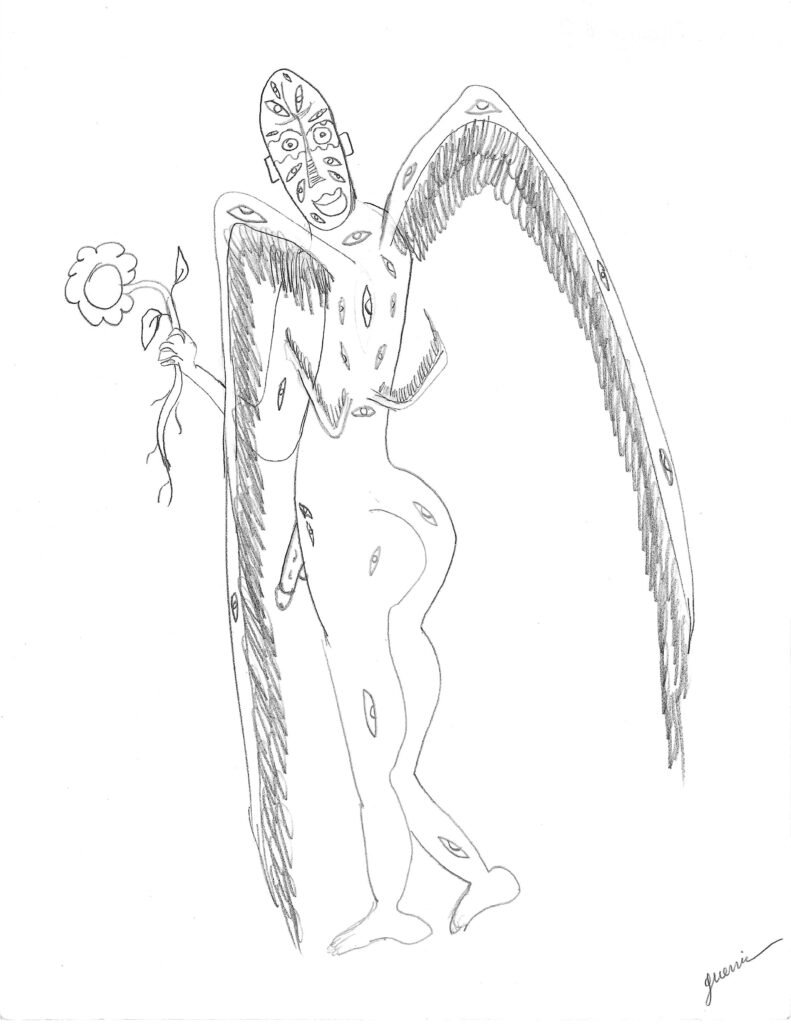
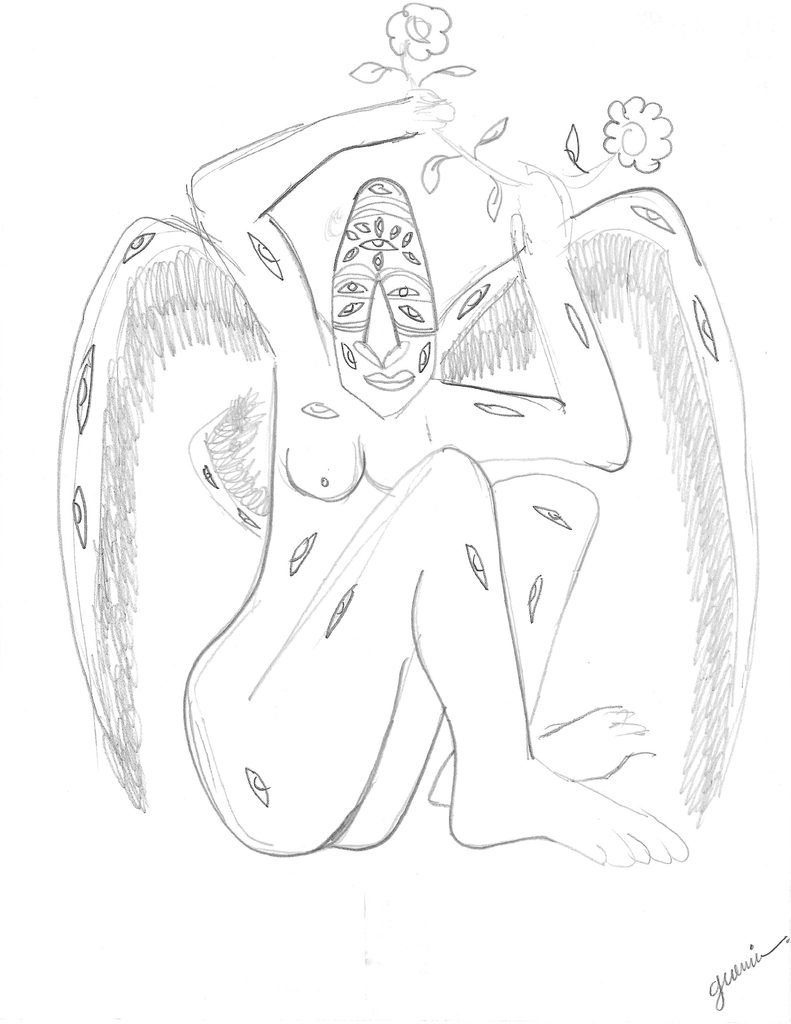
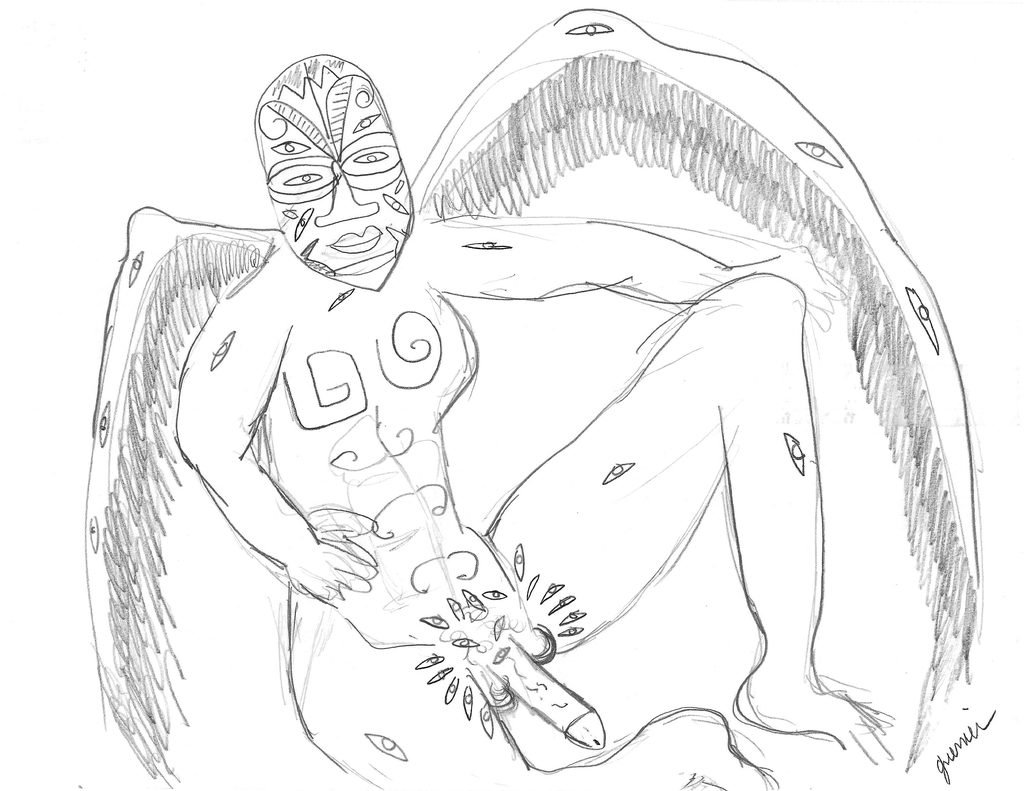
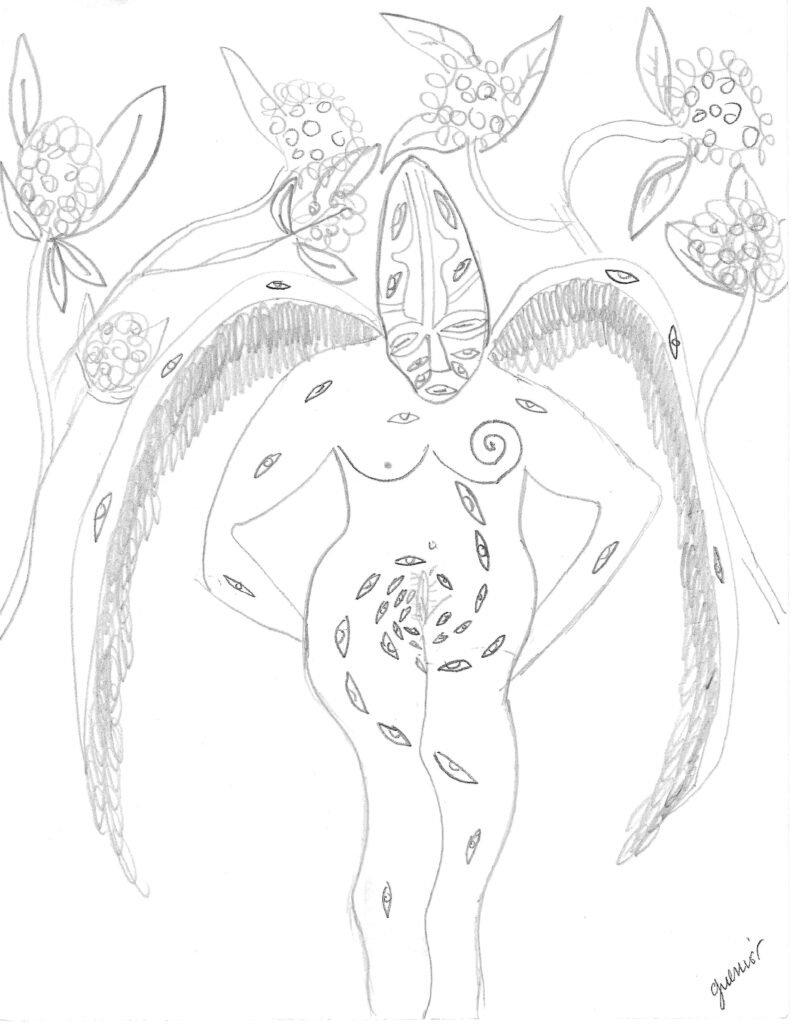
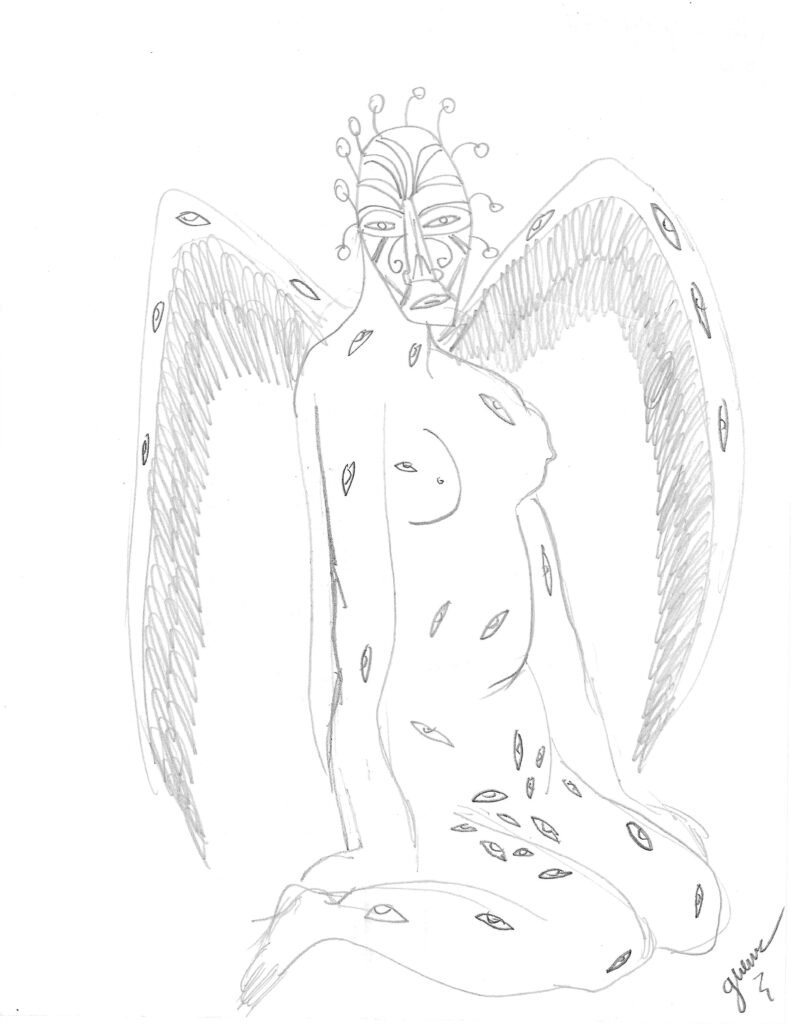
Fabrice Guerrier conceived The Vodou Odyssey as a series of fifty graphite drawings devoted to the lwa, the spirits honored in Haitian Vodou. He describes the project as a dialogue between Pablo Picasso’s deconstructed figures and the religious paintings of the Haitian artist and Vodou priest Hector Hyppolite. The five drawings selected here, nos. 3, 9, 11, 16, and 22 in the portfolio, focus on one of the series’ recurring figures, a winged body covered with eyes. Eyes appear on faces, breasts, genitals, limbs, and wings, so that the entire body seems able to see. Flowers also recur in several of the drawings, linking these many-eyed figures more closely to Guerrier’s dialogue with Hyppolite.
Picasso’s encounter with African sculpture in Paris around 1907 has become one of the defining episodes in histories of Cubism. At the Musée d’Ethnographie du Trocadéro, he saw objects from Africa and Oceania displayed as ethnographic specimens, usually with little information about their makers or their original uses. The masks and carved figures he studied there left a visible mark on Les Demoiselles d’Avignon and on the paintings and sculptures that followed. Many of these objects had reached Europe through colonial expansion and the growing trade in African art. Later accounts of Cubism celebrated what Picasso made from them, while the African artists who created them, along with the meanings the objects held in their original settings, largely disappeared from view.
Guerrier revisits Picasso’s engagement with African art from his own position as a Haitian American artist working with Vodou imagery. The divided faces, angular contours, and bodies seen from several angles recall forms associated with Picasso. In Guerrier’s drawings, they belong to winged, many-eyed beings associated with the lwa. Picasso displaced features and combined viewpoints in order to break apart and reconstruct the human figure. Guerrier draws on this method to imagine bodies that see from several places at once.
Hector Hyppolite’s paintings provide the project’s other main reference. Born in Haiti in 1894, Hyppolite was a houngan, or male Vodou priest, and became one of the most celebrated Haitian painters of the 1940s. He often portrayed the lwa as frontal figures surrounded by flowers and objects associated with their powers. In The Congo Queen, painted around 1946, a veiled mother holding a child recalls the Catholic Madonna and Child and evokes Erzulie Dantor, a protective female lwa. Hyppolite worked within a religious culture in which Catholic images had acquired Vodou meanings over generations.
His international reputation was closely tied to the way Haitian painting circulated abroad during the 1940s. Hyppolite attracted attention after joining the Centre d’Art in Port-au-Prince, founded in 1944 by the American painter DeWitt Peters. André Breton promoted his work, and museums and collectors soon began acquiring his paintings. Artists connected with the Centre d’Art were often described as self-taught, and their work circulated under labels such as “naïve,” “popular,” and “primitive.” Such terms appealed to audiences in search of spontaneous or visionary art, but they also encouraged critics to treat Hyppolite’s paintings as direct expressions of religious instinct. His choices as an artist, and the historical setting in which he worked, received far less attention. Art historians such as Michel-Philippe Lerebours and Carlo A. Célius have questioned the idea that the Centre d’Art marked the beginning of Haitian fine art1. Their research draws attention to the Indigenist movement of the late 1920s and 1930s, when Haitian writers and artists were already turning to rural life, popular culture, Vodou, and the country’s African heritage.
1 Michel-Philippe Lerebours, “The Indigenist Revolt: Haitian Art, 1927–1944,” Callaloo 15, no. 3 (1992): 711–725; Carlo A. Célius, Langage plastique et énonciation identitaire: L’invention de l’art haïtien (Québec: Presses de l’Université Laval, 2007).
The five selected drawings show especially clearly how Guerrier places Picasso’s divided figures in relation to Hyppolite’s representations of the lwa. Split faces and displaced eyes, noses, and mouths recall Picasso’s experiments with human form, while the presence of the lwa connects these features to Hyppolite and to Haitian religious imagery. The most significant change is the multiplication of eyes. They spread across wings, breasts, genitals, arms, and legs until the whole body becomes an organ of sight. Picasso combined several viewpoints in his representations of the body. In Guerrier’s drawings, the body itself sees from several places.
These eyes shape the viewer’s encounter with the drawings. Some stare directly outward, while others look sideways or upward from unexpected parts of the body. The spectator is watched from several directions at once. Eyes also appear on breasts and genitals, making even the most intimate parts of the body look back. Whoever stands before these exposed, intensely physical figures is watched in return.
The altered bodies also suggest movement between human and spirit forms. Wings emerge from shoulders, faces divide, and human figures acquire animal or vegetal traits. Even when they resemble angels or spirits, they retain a physical and erotic presence. Guerrier calls them “Black Angels” and describes their many eyes as a form of “distributed perception.” Their hybrid bodies appear somewhere between human figures and spirit beings, while their many eyes give them powers of sight unavailable to an ordinary human body. Flowers recur especially in nos. 3, 9, and 16, alongside the wings and multiple eyes that connect these figures to the world of the lwa.
Guerrier changes the relation between Picasso and Hyppolite in accounts of modern art. Picasso became an emblem of modernist invention, although his experiments with the human figure were shaped in part by his encounter with African sculpture. Hyppolite’s paintings, meanwhile, entered international collections through categories that often reduced Haitian religious art to instinct or naïveté. In The Vodou Odyssey, Guerrier uses Picasso’s divided figures to depict beings associated with the lwa, while Hyppolite provides an earlier Haitian example of representing these spirits in modern painting. Across these five drawings, the many eyes give that encounter its most distinctive form. Picasso’s multiple viewpoints become eyes distributed across the body, and the figure that is being observed also watches the spectator. In Guerrier’s drawings, the divided figure becomes a many-eyed body associated with the lwa and able to return the viewer’s gaze.
Kombit Curator
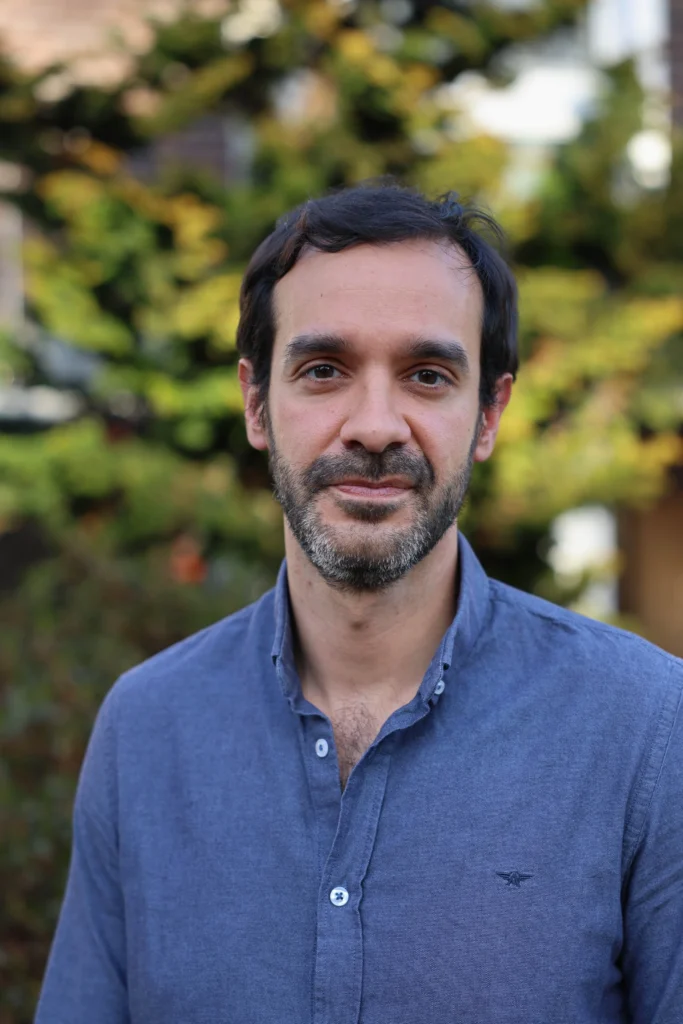
Mariano Villalba is a historian trained in cultural history and religious studies, with a focus on the intersections of politics and spirituality in Latin America. He holds a joint PhD in Religious Studies from the University of Lausanne and in History of Religions and Religious Anthropology from the École Pratique des Hautes Études. His dissertation examined the figure of Arnold Krumm-Heller (1876–1949), a German occultist active during the Mexican Revolution, and analyzed the role of modern esoteric currents in shaping narratives of Mexican national identity.
Villalba is a Postdoctoral Fellow in Spirituality and the Arts at the Center for the Study of World Religions, Harvard Divinity School (2024–2026). His project, Occult Movements and Mexican Mural Art, investigates the influence of Theosophy and related esoteric currents on Mexican visual art, with particular attention to the work of María Izquierdo, Cordelia Urueta, and Sofía Bassi. His research has involved collaborations with the Fondazione Giorgio Cini in Venice, the Warburg Institute in London, and the University of Amsterdam’s Centre for the History of Hermetic Philosophy and Related Currents.
His forthcoming monograph, Occult Mexico: The Imagination of Mexican Antiquity, from the Colonial Era to the Revolution, will be published by Oxford University Press. He is also co-editing a volume on Esotericism and Visual Arts in Latin America. In addition to authoring the texts and curating this exhibition, Villalba has worked on archival and curatorial projects exploring the relationship between art and spirituality and has lectured internationally.